Grooming Your Cat
Grooming Your Cat
If you are planning to own a cat or even if you already have one, you must get your grooming concepts right. You may have a groomer, but even then, it is necessary to know how to groom your cat so she loves as much as you do. When you are grooming your cat for the first time, it is essential to to take into consideration that both you and your cat are new to the thing. Even if you have groomed other cat, you have never groomed this kitty earlier. So, you both are not accustomed to it and agree to it that you both may make mistakes. It's as much a learning lesson for you as it is for your dog.
Get all your things lined up and call your cat in the best voice you have. Let her examine all the things you would be using upon her, for you it's just combs and brush and all but for her it's all alien stuff. So, let her be comfortable with all those articles.
Meanwhile, you get up and get back with a good juicy piece of treat. Let her enjoy the treat and at the same time, play with those combs over her body so that she gets accustomed to it's touch. Now, is the time for action. Remember, slow and steady wins the race. Give soft strokes and slowly move the brush deeper to untangle the messed up hair. The crux of the argument is that it should not come as a shock to your cat.
Use can use a really thin cotton cloth or an old pantyhose and have it fixed over the brush as it will penetrate through the bristles. Once you are done with, you can pull out the cloth piece and all the hair would come out. There is no need to clean the brush for hours.
One way to know if your cat has a good coat or not is to smell it. Yes, simply smelling the coat of your dog can tell you many things about the health of your cat. If it smells bad, that is different from normal, you know there is some problem.
Get all your things lined up and call your cat in the best voice you have. Let her examine all the things you would be using upon her, for you it's just combs and brush and all but for her it's all alien stuff. So, let her be comfortable with all those articles.
Meanwhile, you get up and get back with a good juicy piece of treat. Let her enjoy the treat and at the same time, play with those combs over her body so that she gets accustomed to it's touch. Now, is the time for action. Remember, slow and steady wins the race. Give soft strokes and slowly move the brush deeper to untangle the messed up hair. The crux of the argument is that it should not come as a shock to your cat.
Use can use a really thin cotton cloth or an old pantyhose and have it fixed over the brush as it will penetrate through the bristles. Once you are done with, you can pull out the cloth piece and all the hair would come out. There is no need to clean the brush for hours.
One way to know if your cat has a good coat or not is to smell it. Yes, simply smelling the coat of your dog can tell you many things about the health of your cat. If it smells bad, that is different from normal, you know there is some problem.

Sometimes, even after repeated sessions of proper grooming, your cat may not look healthy in terms of her coat. This can also be a result of poor nutrition. At that time, you must make a chart for about a week, writing down all that you give your pet to eat. Afterwards, take this chart to your vet. It coulg be that the unhealthy coat of your dog is the result of some nutrition deficiency.
When you shampoo your cat, rinse her properly with water, however much she may dislike it otherwise, she will have a skin rash and infection which will be equally detestable. After you have bathed the cat, dry her coat thoroughly. Even a small water on skin can lead to moist eczema, which is commonly referred to as a hot spot. This is not to say that you move the dryer over her for hours.
Do not use any over the counter available shampoo or anti-tick, unless it is recommended by her vet. Sometimes, what may suit other cats perfectly will not suit this cat at all. And, many a times, it is these seemingly safe products that do more harm than good.


Grooming Your Cat


Grooming Your Cat
Cat In The Hat

Cat In The Hat
The Cat in the Hat is a children's book by Dr. Seuss, featuring a tall, anthropomorphic, mischievous cat, wearing a tall, red and white striped hat, a bowtie, and an umbrella. With the series of Beginner Books that The Cat inaugurated, Seuss promoted both his name and the cause of elementary literacy in the United States. The eponymous cat appears in six of Seuss's rhymed children's books:
* The Cat in the Hat
* The Cat in the Hat Comes Back
* The Cat in the Hat Song Book
* The Cat's Quizzer
* I Can Read with My Eyes Shut!
* Daisy-Head Mayzie
* The Cat in the Hat
* The Cat in the Hat Comes Back
* The Cat in the Hat Song Book
* The Cat's Quizzer
* I Can Read with My Eyes Shut!
* Daisy-Head Mayzie


Cat In The Hat
Lolcat

Lolcat
A lolcat is an image combining a photograph, most frequently of a cat, with a humorous and idiosyncratic caption in (often) broken English—a dialect which is known as “lolspeak,” ”kitteh,” or “kitty pidgin” and which parodies the poor grammar typically attributed to Internet slang. The name "lolcat" is a compound word of the acronymic abbreviation "LOL" and the word "cat." A synonym for "lolcat" is cat macro, since the images are a type of image macro. Lolcats are designed for photo sharing imageboards and other internet forums. The term lolcat gained national media attention in the United States when it was covered by Time, which wrote that non-commercialized phenomena of the sort are increasingly rare, stating that lolcats have a distinctly old-school


Lolcat
Ninja Cat
Ninja Cat
Ninja cat has to be the most awesomest kitty out there right now. And the ending with the gigantic eyes… O_O was an instant win


Ninja Cat
Fishing Cat

Fishing Cat
The Fishing Cat (Prionailurus viverrinus) is a medium-sized cat whose disjunct global range extends from eastern Pakistan through portions of India, Nepal and Sri Lanka, throughout Bangladesh and Mainland Southeast Asia to Sumatra and Java. Its fur has an olive-grey color and dark spots roughly arranged in longitudinal stripes. The face has a distinctly flat-nosed appearance. The size is variable; while in India it is 80 cm, or 32 in, (and 30 cm, 12 in, tail), in Indonesia, it is only 65 cm, or 26 in, (25 cm, 10 in, tail). Indian individuals usually range up to 11.7 kg (26 lbs), while in Indonesia common weights are approximately 6 kg (13 lbs). They are stocky of build with medium short legs, and a short muscular tail of one half to one third of their head and body length.
Like its closest relative, the Leopard Cat, the Fishing Cat lives along rivers, brooks and mangrove swamps. It is perhaps better adapted to this habitat, since it swims often and skillfully.

As the name implies, fish is the main prey of this cat, of which it hunts about 10 different species. It also hunts other aquatic animals such as frogs or crayfish, and terrestrial animals such as rodents and birds. The inter-digital webs on its paws help the cat gain better traction in muddy environments and water, like other mammals in semi-aquatic environments.
The Fishing Cat is endangered due to its dependance on wetlands, which are increasingly being settled and converted for agriculture, and also due to human overexploitation of local fish stocks. It is believed extinct in Afghanistan, may already be gone from Malaysia and China, and has become rare throughout its remaining distribution.
Captive Fishing Cats can be seen at 22 different North American institutions. By December 2005, there were 72 Fishing Cats in these institutions.
The Fishing Cat is endangered due to its dependance on wetlands, which are increasingly being settled and converted for agriculture, and also due to human overexploitation of local fish stocks. It is believed extinct in Afghanistan, may already be gone from Malaysia and China, and has become rare throughout its remaining distribution.
Captive Fishing Cats can be seen at 22 different North American institutions. By December 2005, there were 72 Fishing Cats in these institutions.


Fishing Cat
List of Cat Breeds

List of Cat Breeds
Longhair and semi-longhair :
* Aegean crat
* American Longhair
* Asian Semi-longhair (or Tiffanie)
* Balinese
* Birman
* British Longhair
* Chantilly/Tiffany cat
* Himalayan (USA) or Colourpoint (rest of world).
* Javanese
* Maine Coon
* Nebelung
* Norwegian Forest Cat
* Oriental Longhair
* Persian
* Ragdoll (and Ragamuffin)
* Somali
* Siberian
* Turkish Van
* Turkish Angora
* Aegean crat
* American Longhair
* Asian Semi-longhair (or Tiffanie)
* Balinese
* Birman
* British Longhair
* Chantilly/Tiffany cat
* Himalayan (USA) or Colourpoint (rest of world).
* Javanese
* Maine Coon
* Nebelung
* Norwegian Forest Cat
* Oriental Longhair
* Persian
* Ragdoll (and Ragamuffin)
* Somali
* Siberian
* Turkish Van
* Turkish Angora

Shorthair :
* Abyssinian
* American Shorthair
* Australian Mist
* Bombay
* Brazilian Shorthair
* British Shorthair
* Burmese
* Burmilla
* California Spangled Cat
* Chartreux
* Colorpoint Shorthair
* Dragon Li (or Li Hua Mau)
* Egyptian Mau
* European Shorthair
* Exotic
* Havana Brown
* Korat
* Ocicat
* Oriental Shorthair
* Russian Blue
* Russian
* Siamese (and Traditional Siamese or Applehead Siamese)
* Singapura
* Snowshoe
* Sokoke
* Tonkinese
* Ukrainian Levkoy
* Abyssinian
* American Shorthair
* Australian Mist
* Bombay
* Brazilian Shorthair
* British Shorthair
* Burmese
* Burmilla
* California Spangled Cat
* Chartreux
* Colorpoint Shorthair
* Dragon Li (or Li Hua Mau)
* Egyptian Mau
* European Shorthair
* Exotic
* Havana Brown
* Korat
* Ocicat
* Oriental Shorthair
* Russian Blue
* Russian
* Siamese (and Traditional Siamese or Applehead Siamese)
* Singapura
* Snowshoe
* Sokoke
* Tonkinese
* Ukrainian Levkoy

Breeds based on mutations :
* American Bobtail
* American Curl
* American Ringtail
* American Polydactyl (a pedigree form of Hemingway Cat/Mitten Cat)
* American Wirehair
* Cornish Rex
* Cymric
* Devon Rex
* Don Sphynx (Donskoy)
* German Rex
* Japanese Bobtail
* Kuril Bobtail
* LaPerm
* Manx
* Munchkin
* Ojos Azules
* Peterbald
* Pixie-bob
* Selkirk Rex
* Scottish Fold
* Sphynx
* Urals Rex
* American Bobtail
* American Curl
* American Ringtail
* American Polydactyl (a pedigree form of Hemingway Cat/Mitten Cat)
* American Wirehair
* Cornish Rex
* Cymric
* Devon Rex
* Don Sphynx (Donskoy)
* German Rex
* Japanese Bobtail
* Kuril Bobtail
* LaPerm
* Manx
* Munchkin
* Ojos Azules
* Peterbald
* Pixie-bob
* Selkirk Rex
* Scottish Fold
* Sphynx
* Urals Rex

Breeds derived from Hybridisations between domestic Cats & wild Felids
* Bengal : domestic Cat / Asian leopard cat (Prionailurus bengalensis)
* Bristol : domestic Cat / Margay (Leopardus wiedii)
* Chausie : domestic Cat / Jungle Cat aka swamp-lynx (Felis chaus)
* Cheetoh : Ocicat / Bengal
* Jungle-Bob : Pixie-bob / Jungle Cat aka swamp-lynx (F. Chaus)
* Jungle-Curl : Hemingway Curl aka American Curl / Jungle Cat aka swamp-lynx (Felis chaus)
* Machbagral and/or Viverral : domestic Cat / Fishing Cat (Prionailurus viverrinus)
* Pantherette : Pixie-bob / Asian leopard cat (Prionailurus bengalensis)
* Punjabi : (domestic Cat with Indian Desert-Cat aka Asiatic Wildcat (Felis s. ornata)
* Safari : (domestic Cat with Geoffroy's Cat (Leopardus geoffroyii)
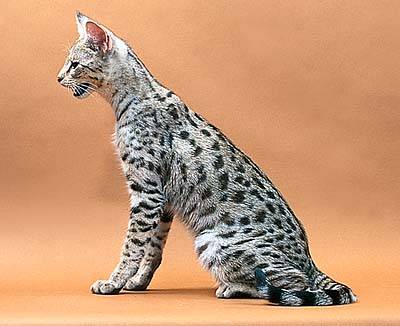
* Savannah and/or Ashera : (domestic Cat with Serval (Leptailurus serval)
* Serengeti : Oriental / Bengal
* Stone Cougar : domestic Cat / Jungle Cat aka swamp-lynx (Felis chaus) (different from Chausie)
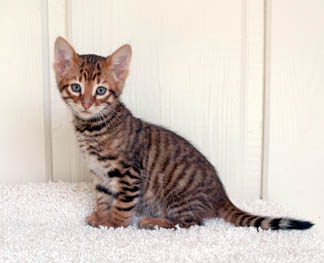
* Toyger : domestic Cat / Bengal
* Ussuri (cat) : domestic Cat / Amur Asian leopard cat (Prionailurus b. euptailura)
* Caracat : Domestic Cat / Caracal
* Domestic Cat / Oncilla (Little Spotted Cat/Tiger Cat) (all 3 surviving hybrids were sterile; there is no proposed name for this type of hybrid)
* Domestic Cat / Black-footed Cat (F. nigripes)
* Domestic Cat / Rusty-spotted Cat (Prionailurus rubiginosus) (wild-occurring Hybrids, India)
* Domestic Cat / Ocelot (2 known litters, there is no proposed name for this type of hybrid)
* Bristol : Domestic Cat / Margay
* Bengal : domestic Cat / Asian leopard cat (Prionailurus bengalensis)
* Bristol : domestic Cat / Margay (Leopardus wiedii)
* Chausie : domestic Cat / Jungle Cat aka swamp-lynx (Felis chaus)
* Cheetoh : Ocicat / Bengal
* Jungle-Bob : Pixie-bob / Jungle Cat aka swamp-lynx (F. Chaus)
* Jungle-Curl : Hemingway Curl aka American Curl / Jungle Cat aka swamp-lynx (Felis chaus)
* Machbagral and/or Viverral : domestic Cat / Fishing Cat (Prionailurus viverrinus)
* Pantherette : Pixie-bob / Asian leopard cat (Prionailurus bengalensis)
* Punjabi : (domestic Cat with Indian Desert-Cat aka Asiatic Wildcat (Felis s. ornata)
* Safari : (domestic Cat with Geoffroy's Cat (Leopardus geoffroyii)
* Savannah and/or Ashera : (domestic Cat with Serval (Leptailurus serval)
* Serengeti : Oriental / Bengal
* Stone Cougar : domestic Cat / Jungle Cat aka swamp-lynx (Felis chaus) (different from Chausie)
* Toyger : domestic Cat / Bengal
* Ussuri (cat) : domestic Cat / Amur Asian leopard cat (Prionailurus b. euptailura)
* Caracat : Domestic Cat / Caracal
* Domestic Cat / Oncilla (Little Spotted Cat/Tiger Cat) (all 3 surviving hybrids were sterile; there is no proposed name for this type of hybrid)
* Domestic Cat / Black-footed Cat (F. nigripes)
* Domestic Cat / Rusty-spotted Cat (Prionailurus rubiginosus) (wild-occurring Hybrids, India)
* Domestic Cat / Ocelot (2 known litters, there is no proposed name for this type of hybrid)
* Bristol : Domestic Cat / Margay

Breeds derived from multiple Hybridisations between domestic Cats & Felids
* Chausie / African Wildcat (F. s. lybica) (no breed name has been proposed)
* Euro-Chausie : Chausie / European Wildcat (F. s. silvestris) or Scottish Wildcat (F. s. grampia)
Attempted or unconfirmed Hybridisation between domestic Cats & Felids
* Jaguarundi Curl (alleged name) aka Mandalan Jaguar (proposed name) : Domestic Cat / Jaguarundi
* Domestic Cat / Canada Lynx
* Domestic Cat / Bobcat (Felis rufus)
* Domestic Cat / Pallas Cat (Otocolobus manula)
* Chausie / African Wildcat (F. s. lybica) (no breed name has been proposed)
* Euro-Chausie : Chausie / European Wildcat (F. s. silvestris) or Scottish Wildcat (F. s. grampia)
Attempted or unconfirmed Hybridisation between domestic Cats & Felids
* Jaguarundi Curl (alleged name) aka Mandalan Jaguar (proposed name) : Domestic Cat / Jaguarundi
* Domestic Cat / Canada Lynx
* Domestic Cat / Bobcat (Felis rufus)
* Domestic Cat / Pallas Cat (Otocolobus manula)


List of Cat Breeds
Black Cat Fireworks

Black Cat Fireworks
Black Cat Fireworks and Standard Fireworks are the most popular and well known firework brands in the UK and world markets.


Black Cat Fireworks
Names for Kittens

Names for Kittens
Cat names are a vast and interesting domain. Explore through the twists and turns of this domain. Name your cat with a unique name and make it a member of your household. Naming cat is a personal decision. There are so many kittens names to choose from. Often a perfect name pops up in your mind. It requires a little inspiration to name your cat in your own way. Name your feline companion with a unique name. If you want some innovative and uncommon names for your male and female cats, please read this article. We would provide you a list of male and female cat names that are cute and dainty, which would certainly give you an idea and then depending on the breed, color and characteristics of the cat, you can name your kittens.
The cat’s domestic and wild have intrigued man for thousands of years, and throughout that time the relationship of these animals with man has varied widely. Man has valued cats as hunters, worshiped them as gods, and sacrificed them as demons. Whatever their fortunes, however the animals have survived and still hold great fascination for humans. They have often been used as symbols of beauty, grace, mystery, and power, and they have been favorite subjects for many artists and writers.

Today, the domestic cat (house kittens) is second only to the dog in popularity as a house pet. No one knows exactly how many domestic cats there are in the United States, but researchers estimate that more than 30 million are owned as pets. There is no way to estimate the numbers of homeless cats that roam about freely as feral animals (those that had been tame but have returned to living in a wild state). There probably are many millions of such cats wandering about in the streets and alleys of cities and towns across the country.


Names for Kittens
Subscribe to:
Posts (Atom)